
WALL & CEILING LEAK DETECTION — PASADENA, CA
Wall & Ceiling Leak Detection
in Pasadena, CA
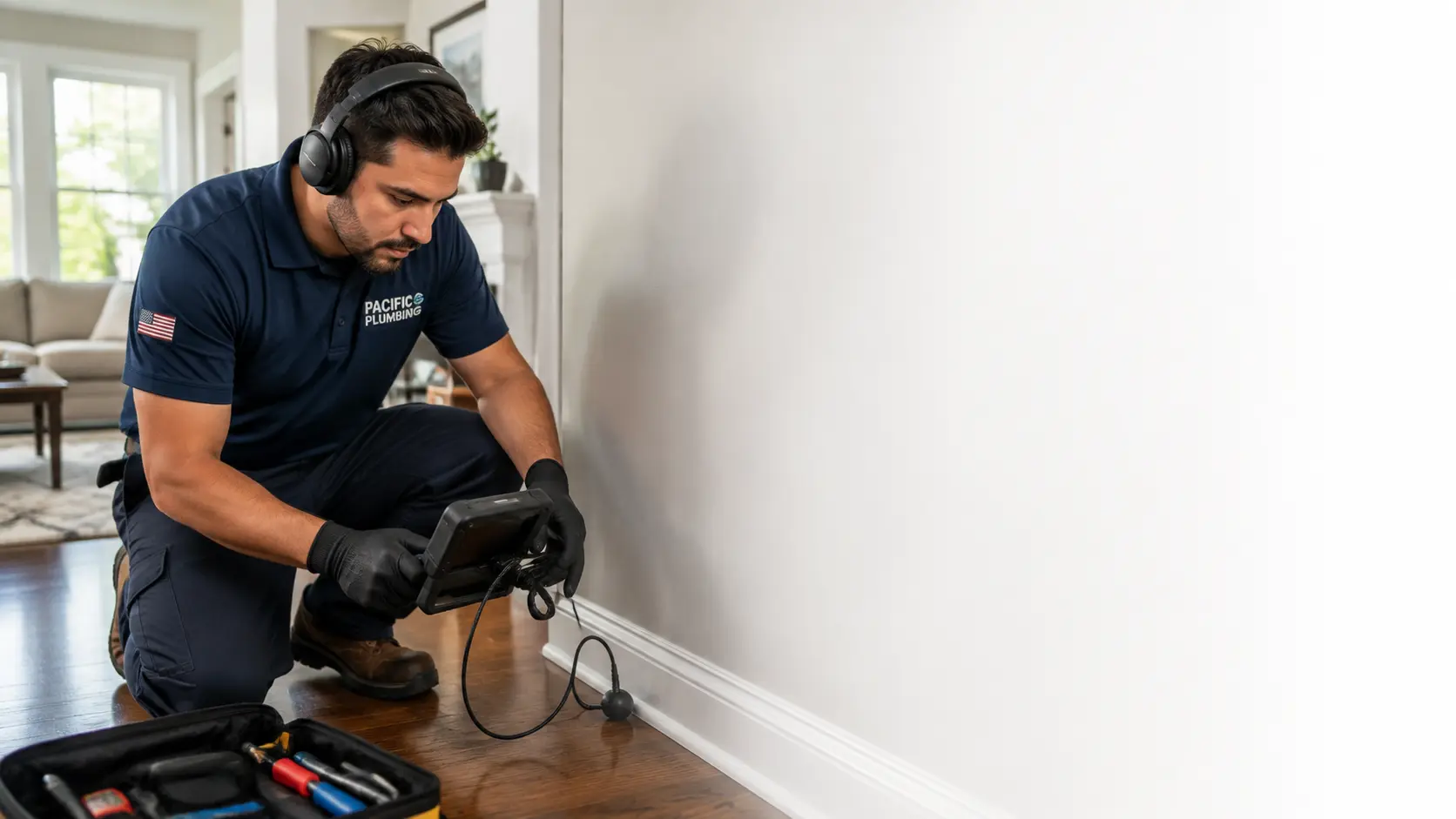
Thermal imaging and acoustic sensors find the exact pipe before anyone opens anything.
One targeted access point. Not a section torn open to search. Craftsman bungalow and historic property specialists.
✓ No Unnecessary Demolition · ✓ Thermal Imaging & Acoustic Detection · ✓ Craftsman Home Specialists · ✓ CA C-36 Licensed · ✓ 24/7
🔥 Thermal Imaging
🎯 Acoustic Detection
🏛️ Bungalow Heaven Specialists
🚫 No Unnecessary Demo
📋 Written Report
WHY THE STAIN IS NEVER WHERE THE PIPE BROKE
Opening the Wall at the Stain Is the Worst Thing You Can Do First
The ceiling stain in your Bungalow Heaven craftsman wasn’t there last week. Or the paint near the upstairs bathroom is bubbling. Or a room smells musty with no visible water anywhere. These are wall and ceiling leak symptoms — and the pipe causing them is almost never where the stain appears.
Water follows the path of least resistance. It runs down studs, along joists, under subfloor, and pools at the lowest accessible point before becoming visible. The stain marks where the water stopped — not where the pipe failed. The actual failure can be 2–6 feet above or to the side. Our acoustic detection equipment hears the exact pipe before we touch anything.
We find the exact pipe location using thermal imaging cameras and acoustic contact microphones. One targeted access point is recommended — not a section opened for searching. In a historic Pasadena property with original lath-and-plaster walls, opening the wrong section can cost $500–$2,000 per square foot in verified historic restoration.

WARNING SIGNS
Signs You Have a Wall or Ceiling Leak in Your Pasadena Home
| Symptom | Likely Pipe Location | Common Cause in Pasadena |
|---|---|---|
| Yellow or brown ceiling stain — dry to the touch | Pipe above ceiling; leak is intermittent or has stopped | Wax ring failure, shower pan crack, or fitting that leaks only under pressure |
| Ceiling stain that grows or feels wet and soft | Active leak directly above — urgent | Supply line connection failure, cracked copper fitting, or pinhole corrosion |
| Bubbling or peeling paint on a wall | Pipe inside the wall cavity leaking slowly | Galvanised pipe corrosion, copper pinhole from hard water, or compression fitting failure |
| Soft or spongy drywall/plaster — no stain visible | Moisture trapped behind the surface | Water travelling horizontally along a joist before reaching the surface |
| Persistent musty smell — no visible water | Hidden moisture in wall cavity — mould forming | Slow pinhole leak running for weeks without visible breakthrough |
| Warm or damp area on a wall — no explanation | Hot water supply line leaking inside the wall | Copper pinhole from PWP hard water scaling; fitting failure at an elbow or T |
⚠️ ACTIVE EMERGENCY: If water is actively running down a wall, dripping from a ceiling, or pooling on a floor — shut off your main water supply at the curb immediately (turn clockwise). Then see our 24/7 emergency leak detection service. Call (626) 687-0576 and tell us water is actively spreading. We dispatch differently for active emergencies.
DETECTION PROCESS
How We Find Wall and Ceiling Leaks Without Opening Anything
Step 1 — Thermal Imaging Scan (10–20 min)
Infrared camera detects temperature differences on the wall or ceiling surface. A hot water leak creates a warm zone. A cold water leak creates a cool zone as water evaporates. We scan the affected area and adjacent surfaces the leak may have tracked to.
Step 2 — Acoustic Contact Microphone Sweep
Contact microphones pressed against the wall or ceiling surface narrow the location to the specific pipe and fitting. We use the same acoustic detection technology applied to underground leaks — calibrated here for in-wall pipe materials.
Step 3 — Moisture Mapping
A handheld moisture meter scanned across the surface maps moisture distribution behind the finish material — critical for mould risk assessment and insurance documentation.
Step 4 — Pressure Isolation Test
For multi-story Pasadena homes, we isolate pipe sections with isolation valves to confirm which run contains the leak. This tells us immediately whether the source is above the ceiling stain or in a pipe shared between floors.
Step 5 — Written Report & Targeted Access Recommendation
Before we recommend opening anything: leak location, pipe identified, moisture distribution map, and the smallest possible access point. For historic properties, the report includes finish material notes and restoration approach for the repair contractor. The report also qualifies for PWP’s Water Leak Assistance Program.
HISTORIC PASADENA PROPERTIES — A DIFFERENT STANDARD
We Don’t Touch Historic Materials Until We Know Exactly Where the Pipe Is
🏛️ Bungalow Heaven (91103–04)
800+ homes built 1900–1930 on the National Register of Historic Places. Original lath-and-plaster walls, fir floors, period hardware, non-standard plumbing chases. We scan first and access second — at the confirmed location only, minimum opening necessary.
🏡 Oak Knoll / Madison Heights (91105–06)
Mid-century construction with preserved original bathroom tile — Pasadena’s hard water creates scale patterns in period tile that are impossible to replace authentically. We detect leaks in tiled wet areas without touching a single tile unless the confirmed location requires it.
🏰 Arroyo Terrace Spanish Colonial (91105)
Thick stucco exterior walls, clay tile roofing, interior plaster. Spanish Colonial stucco colour-matching after repair is nearly impossible. We do not recommend stucco access without confirmed acoustic and thermal confirmation of the exact pipe location.
🏢 Old Pasadena Commercial (91103)
Pre-war commercial construction along Colorado Boulevard. Supply lines in ceiling voids above suspended tile ceilings — acoustic detection through ceiling tiles is the primary method. We coordinate with property managers to work around business hours and minimise tenant disruption.
WHAT CAUSES WALL & CEILING LEAKS IN PASADENA
The Most Common Sources We Find in Pasadena Homes
Copper Pipe Pinhole Leaks — Most Common
PWP supplies Pasadena above 15 grains per gallon water hardness. Hard water deposits calcium and magnesium on copper pipe interiors over decades. Pinholes develop at elbows, T-junctions, and solder connections. A pinhole drips for weeks inside the wall before moisture breaches the surface — acoustic detection picks it up long before the stain appears.
Failed Wax Rings & Shower Pan Failures
A failed toilet wax ring leaks every time the toilet is flushed — into the subfloor, then the ceiling below. The most frequent ceiling leak call in Pasadena’s 1950s–70s two-story homes. The ceiling stain only appears after the subfloor has absorbed all the moisture it can hold.
Galvanised Steel Pipe Corrosion
Pre-1960 Pasadena homes in Bungalow Heaven and Madison Heights often still have original galvanised steel supply lines inside the walls. Galvanised corrodes from the inside out — rust builds as scale, eventually perforating the pipe. Also see our pipe leak detection service for full system tracing.
Compression Fitting Failures
Every elbow, T-junction, and shutoff valve uses a fitting. Fittings are the highest-failure-rate components in any plumbing system. A fitting that worked fine for twenty years can fail when the pipe expands in a temperature change — or when PWP raises line pressure after main maintenance in the area.
FREQUENTLY ASKED QUESTIONS
Wall & Ceiling Leak Detection FAQs — Pasadena, CA
How do you find a wall leak without tearing up the wall?
Thermal imaging cameras detect temperature differences on the wall surface caused by moisture behind it. Acoustic contact microphones pressed against the wall pick up the sound of water escaping the pipe inside. Together, these locate the leak to within a few inches before any surface is touched. We then recommend the minimum access point — not a section opened to search.
Why is the ceiling stain not directly below the leak?
Water runs along the path of least resistance — down the nearest stud or joist before dripping off the lowest accessible point. That point becomes the visible stain. The pipe failure can be 2–6 feet from the stain in any direction. This is why opening the wall at the stain location frequently finds nothing.
Can you detect a wall leak in a historic Pasadena craftsman home without damaging the plaster?
Yes — and this is specifically what our approach is designed for. Thermal cameras and acoustic contact microphones work through original lath-and-plaster without any surface contact. The plaster is not drilled or cut until the location is confirmed to the point where one targeted opening is sufficient. We’ve worked in registered historic homes throughout Bungalow Heaven and Arroyo Terrace.
How do I know if the ceiling stain is from a plumbing leak or a roof leak?
Roof leaks appear or worsen during rain and often disappear between rain events. Plumbing leaks are present regardless of weather and typically worsen when water is used in the building. If the stain is worst after a shower on a dry day — it’s almost certainly plumbing. Thermal imaging confirms moisture presence regardless of whether the leak is active at the moment of inspection.
Does homeowners insurance cover wall and ceiling leak repairs in California?
California homeowners insurance typically covers sudden, accidental water damage — a pipe failure damaging walls or ceilings is usually covered. What insurers require: a written report documenting the leak location, cause, and detection date. Our written detection report includes everything your insurer will ask for.
What should I do while waiting for the detection appointment?
Don’t open the wall yourself. Place a container under any active drip. Photograph the stain and note any size changes. If water is actively running — shut off the main supply at the curb (turn clockwise). Call (626) 687-0576 and we’ll advise whether same-day dispatch is needed. For serious active leaks, visit our emergency leak detection page.
Wall or Ceiling Stain? Call Before Anyone Opens Anything.
Thermal imaging · Acoustic detection · Moisture mapping · Craftsman bungalow specialists
All Pasadena ZIP codes 91101–91107 · Altadena · South Pasadena · San Marino. See all our Pasadena leak detection services.